


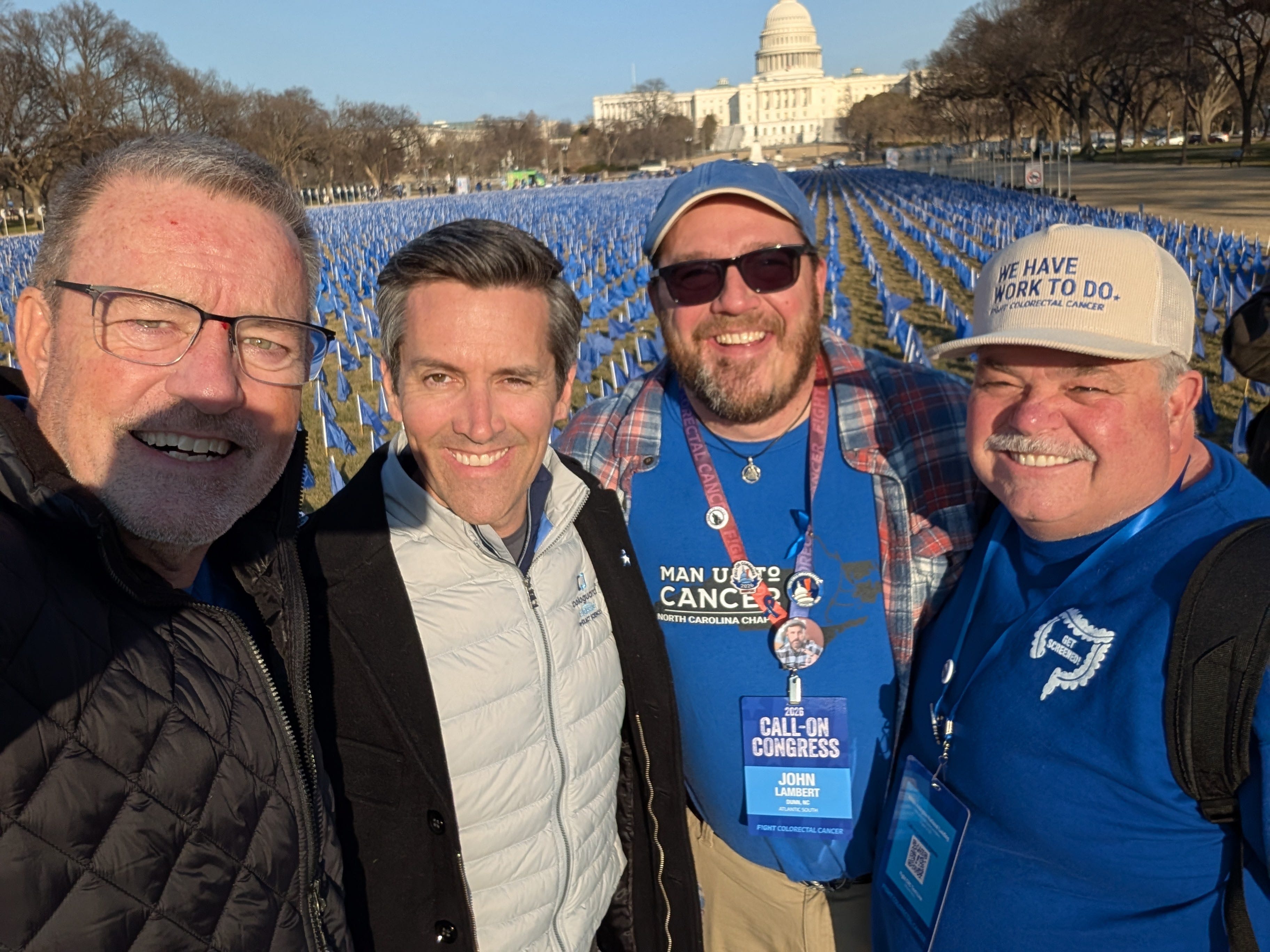
Call on Congress, 2026. Men showing up for colorectal cancer advocacy on the National Mall.
Look around the room at almost any patient advocacy conference, advisory council, or community health event, and you’ll notice something. The space is overwhelmingly populated by women — brilliant, driven, deeply committed women who have built much of what makes patient advocacy as powerful as it is today. This isn’t a critique. It’s an observation. And it’s followed immediately by a question that I keep coming back to:
Where are all the men?
This isn’t a hypothetical. I’ve been a patient advocate for over five years, a colorectal cancer survivor who stumbled into this work the way many of us do: through crisis, followed by a slow realization that my story had the power to help someone else. Along the way, I’ve sat on research panels, walked the halls of Congress, served in community leadership roles with Man Up to Cancer and Fight Colorectal Cancer, and built a platform around advocacy work. I’m proud of all of it. But I’m also acutely aware that I’m often the exception in these spaces, not the rule.
Men are living with cancer, chronic illness, and complex diagnoses in significant numbers. And yet, when it comes to raising their voices, joining advisory councils, or showing up for advocacy days — something keeps getting in the way.
I want to talk about what that something is.
The Numbers Don’t Lie — But They Don’t Tell the Whole Story Either
Men still carry a slightly higher overall cancer incidence rate than women, though that gap has been narrowing. Colorectal cancer — the disease that brought me into this work — continues to affect men and women in significant numbers, and early-onset cases are rising sharply across both groups.
And yet the pipeline of male patient advocates remains thin.
The disparity becomes even clearer when you look at related data on help-seeking behavior. Research consistently shows that men are far less likely to seek support — for health concerns, mental health struggles, or even basic preventive care. According to recent data, 55% of men don’t complete regular health screenings, and 63% skip annual medical visits altogether. As many as 70% of young men avoid mental health services entirely.
Those aren’t just abstract statistics. Those are men who never make it to the starting line of advocacy because they haven’t yet let themselves be patients in the first place.
The Wall That Stops Men Before They Start
If you want to understand why men resist becoming advocates, you have to start with what keeps them from even acknowledging they need help.
Research on masculinity and health behavior paints a consistent picture: traditional masculine norms — the “be strong, stay in control, handle it yourself” script that most of us absorbed before we were old enough to question it — create a profound barrier to help-seeking of any kind. Depression is described in the research literature as being fundamentally “incompatible” with traditional masculinity, because it’s associated with feelings of powerlessness and vulnerability. The same logic applies to chronic illness, survivorship, and certainly to standing up publicly and saying this happened to me, and I need things to change.
I felt it myself. When I was first diagnosed, my instinct wasn’t to reach out — it was to research alone, process quietly, and present the composed version of events to everyone around me. The idea of being publicly identified as a patient, let alone an advocate, felt uncomfortably close to something I hadn’t been taught to be: visibly fragile.
What broke through for me was community. Specifically, it was finding other men who had gone before me — who were strong and open, resilient and honest, who hadn’t traded their identity for their diagnosis but had let their diagnosis deepen it. Man Up to Cancer was a revelation in that way. A room full of men processing illness together, fiercely and sometimes tearfully. Not despite their masculinity. Through it.
But not every man finds that room. And the patient advocacy world — mostly unintentionally — doesn’t always make it easy.
The Advocacy Space Has a Messaging Problem
Here’s where I want to be honest, even if it’s a little uncomfortable.
Much of the existing patient advocacy infrastructure — the language, the imagery, the emotional framework — was built by and for women. Again, this isn’t a criticism. It reflects who showed up, and who showed up is who built it. But as a result, many of the entry points into advocacy feel culturally misaligned for men who are still working through what it means to be a patient at all.
Research on men’s mental health engagement found that campaigns emphasizing vulnerability or emotional openness can actually backfire with male audiences if not carefully framed — reinforcing the perception that seeking help is “unmanly” rather than dismantling it. There’s a scarcity of male role models in health advocacy. When men see other men — especially men they respect — speaking openly about illness and the need for change, it normalizes the path. Without those models, the road into advocacy feels like a solo journey into unfamiliar territory.
There’s also the practical matter of framing. Men often respond better to action-oriented language — to advocacy positioned not as “sharing your feelings” but as doing something that matters. The research. The policy work. The walking of the halls. The testifying. These are the entry points that can reach men who would never respond to a call for emotional expression but will absolutely respond to a call for impact.
I became an advocate because I wanted to do something with what had happened to me. The emotional openness came later — and it came because I was already in the work.
What Breaks Through
In my experience, three things shift the equation for men:
Another man going first. This is almost universal. The men I’ve seen step into advocacy rarely found their way there alone. Someone they trusted — a friend, a fellow patient, a doctor who spoke plainly — invited them into it. The invitation matters more than we think.
A mission they can name. “Come share your story” is a harder ask than “help us change a screening guideline” or “join us in Washington to fight for funding.” Men who would hesitate to process their experience publicly will often show up when the goal is concrete. Start with the mission. The story follows.
Permission to be exactly who they are. This is where Man Up to Cancer gets it right. There’s no requirement to be soft or to perform a particular kind of emotional openness. You can be funny, you can be angry, you can be stoic. The only requirement is showing up. That permission — to be a man and an advocate, without having to become something else first — is the thing that removes the wall.
What the Advocacy Community Can Do
If you’re a patient advocacy organization, a conference organizer, or someone who builds community in health spaces, I’d offer this:
Look at your imagery, your language, and your speaker lineups. Not to apply some kind of gender quota, but to ask honestly: Does a man who has never been in this world see himself here? If the answer is no, that’s worth addressing.
Create pathways that lead with mission and action, not just emotional process. Both matter, but the action-first door is often the one that men will actually walk through.
Find the men who are already in your community and ask them to do the inviting. Peer-to-peer recruitment among men is extraordinarily powerful. It’s often how I ended up in rooms I never would have found on my own.
And finally — celebrate the men who are advocating. Not in a tokenizing way, but in a “you belong here and your voice matters” way. Visibility creates more visibility.
A Note to the Men Reading This
If you’ve survived something — a cancer diagnosis, a chronic condition, a medical journey that changed how you see the world — and you’ve wondered whether advocacy is something you could do, I want to be direct with you:
It is. You don’t have to have all the answers, or speak perfectly, or have processed everything completely. You just have to be willing to show up and tell the truth about what you experienced and what you need changed.
The advocacy space needs your voice. Not because men are underrepresented as some kind of diversity metric, but because the decisions being made in research labs, in congressional offices, and in hospital boardrooms affect men, too, and the people in those rooms need to hear from us.
I spent the first part of my advocacy life feeling like a guest in someone else’s house. Somewhere along the way, that changed. I realized I wasn’t a guest. I belonged there. So do you.
Tim McDonald is a colorectal cancer survivor, patient advocate, author of From Patient to Advocate, and host of the Advocacy at Work podcast and Substack. He serves with Fight Colorectal Cancer, Man Up to Cancer, HOPA’s Patient Advisory Panel, and the PAN Foundation.
This is a great post. Tim. Much of what you’re talking about is the stigma surrounding masculinity and cancer, which can be even more complex when intersectionality is considered (cancer type, race ethnicity & culture, sexuality. Socioeconomic status, etc). Your messaging about overcoming this through tailored communication, etc. is spot on. This would be a great article!! 😄