


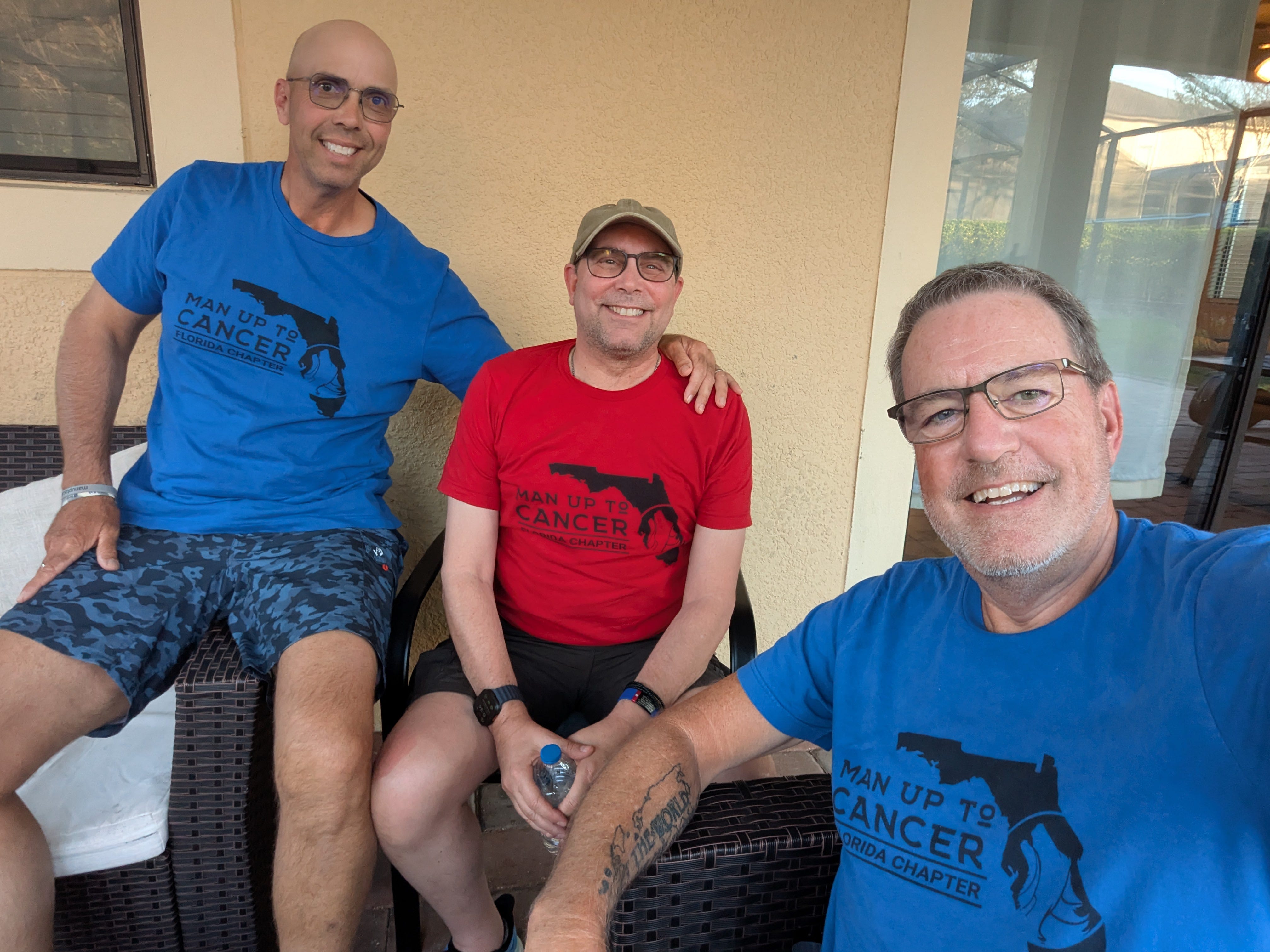
Connection with other men affected by cancer has meant a lot to me. As I build Between Scans, I want to help more men find that connection after treatment ends. Pictured here with friends through Man Up to Cancer’s Florida chapter.
When cancer treatment stops, people around you may finally exhale.
You made it through. You should feel relieved. Now you can get back to your life.
But what if that’s not how you feel?
What if the appointments slow down and the worry gets louder? What if every new ache raises a question you don’t want to ask? What if everyone thinks you’re doing well, but you’re still trying to figure out what comes next?
That’s the part I want to talk about.
A recent Stanford Medicine article describes research that looked at the connection between mental health and cancer survival. It’s also a reminder of why I’m working on Between Scans—a peer-support project I’m planning to launch in early 2027 for men in the first two years after active cancer treatment ends.
What the research found
Researchers analyzed data from 22,281 people diagnosed with cancer in the UK Biobank. Mental health disorders identified two to five years after a cancer diagnosis were associated with a 119% higher rate of death from cancer compared with people without documented mental health disorders during that period.
That’s a finding worth paying attention to. But it needs context.
The study does not show that mental illness causes cancer to progress. The researchers explain that a mental health diagnosis may help identify people facing distress, treatment complications, barriers to care, or other challenges associated with poorer survival. Gaps in ongoing support could be part of the picture.
And the clock in this study starts at diagnosis—not at the end of treatment.
I’m not reading this as proof that a support group will change someone’s cancer outcome. I’m reading it as another reason not to assume that someone’s need for support ends when treatment does.
That’s where Between Scans comes in
I’m building Between Scans for men who are in that first 0–24-month stretch after active treatment stops.
The plan is to start with a 15-man pilot in Tampa Bay: small groups led by trained peer facilitators who are survivors themselves, with a licensed clinical partner available for people who need support beyond what a peer group can provide.
Not therapy. Not a lecture. And not another place where you have to tell everyone you’re fine.
A place to talk with other men who understand why being “done with treatment” doesn’t necessarily mean you feel done with cancer.
Maybe it’s the worry before a scan. Maybe it’s figuring out work, relationships, or what your body can do now. Maybe you don’t have a clear name for it. You just know things don’t feel the way you expected.
You shouldn’t have to have it all figured out before reaching out.
If this sounds familiar, I’d like to hear from you
If you’re a man in the Tampa Bay area who has finished active cancer treatment within the past two years, or expects to finish before our planned early-2027 launch, I’d like to connect.
You don’t need to belong to an advocacy organization. You don’t need experience with support groups. And contacting me doesn’t commit you to joining anything.
I’d like to hear what this period has been like for you, what support you wish you had, and whether you’d be interested in learning more as the pilot takes shape.
Email me at timamcdonald@gmail.com with “Between Scans” in the subject line.
If you know a man who might recognize himself in this, please share it with him.
Treatment ending is a milestone. It shouldn’t mean having to figure out everything that follows on your own.