


From three years of ignored symptoms to Capitol Hill: Andy Goodspeed’s journey from expecting to die to fighting for others not to miss the warning signs
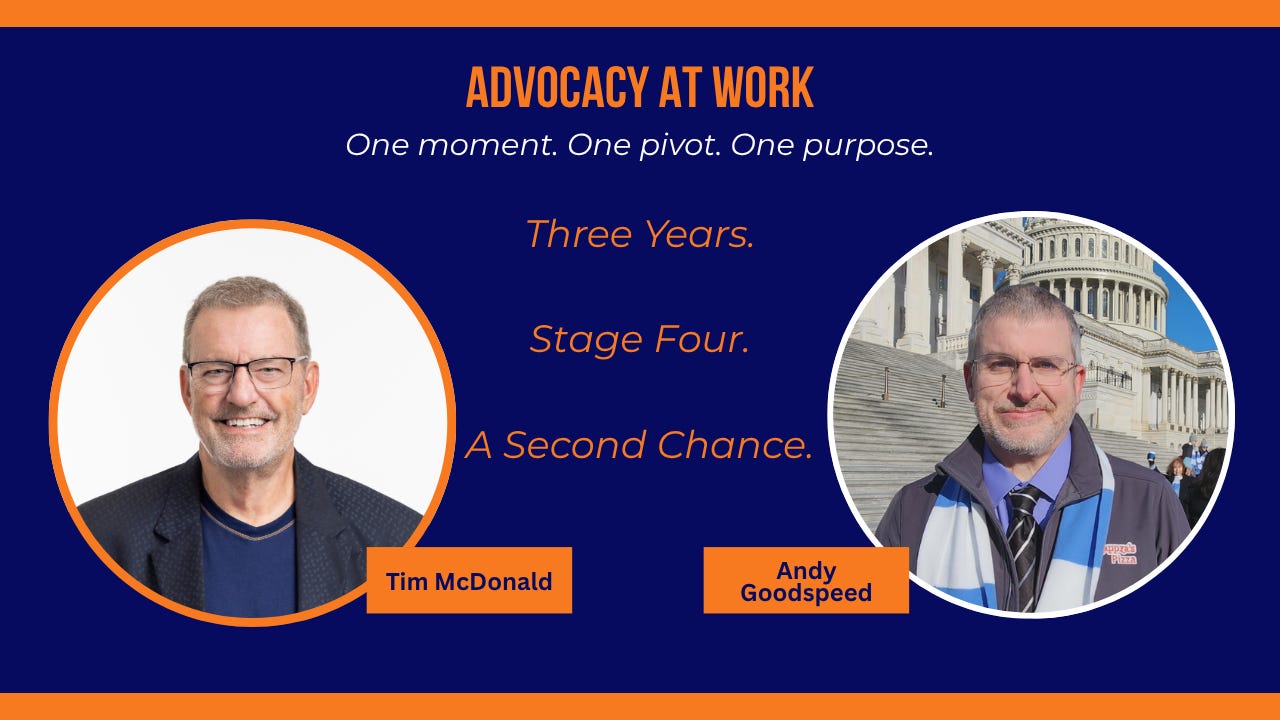
It started on a vacation to Miami Beach in 2020.
As early as 2018, Andy Goodspeed noticed something was off. Severe heartburn. Stomach cramping. General fatigue. Back pain that seemed to come out of nowhere, shooting up and down his spine. But being a man in his fifties with a career in the restaurant industry, he did what so many of us do: he ignored it.
“It’s just getting old,” he told himself. “It’s just the job.”
Then 2020 happened. COVID was spreading. Going to the doctor seemed like a bad idea. So Andy kept pushing the symptoms aside, self-medicating with over-the-counter Advil, keeping his local pharmacy well-stocked and unaware that every month that passed was potentially costing him years of his life.
By early 2021, nearly three years after his first symptoms, his wife finally convinced him to see a doctor. What came next was a diagnostic journey that would change everything: a misdiagnosis, worsening symptoms, falling asleep while standing at his restaurant job, more blood tests, and finally, the endoscopy that revealed the truth.
A large ulcer. One inch across. Perforated through the stomach wall. Cancer positive.
Then came the MRI. And that’s when Andy’s life fractured into before and after.
The Christmas Tree Moment
Andy describes his first cancer scan in a way that will stay with me.
“If you look at a Christmas tree on Christmas morning,” he says, “you see all those nice little presents and all those nice bright lights on the Christmas tree, and it’s sparkly and it’s magical. That’s what I saw. But unfortunately, it was on my MRI scan.”
The lights on that scan weren’t magical ornaments. They were tumors. Ninety percent of his bones showed evidence of cancer. There were tumors in his lymph nodes. In his liver.
He had stage four gastric cancer. He had been given six months to live.
He remembers his wife crying. The nurse crying—though she tried to hide it. The out-of-body experience of hearing those words. And his joy of Christmas, from that moment forward, was tied to the image of his own body lit up with cancer.
Three Years of Missing It: Why Early Detection Matters
Here’s the thing that haunts Andy, and what’s driving his advocacy work: he ignored symptoms for nearly three years before he saw a doctor.
Three years.
And here’s the cruelest part: when he finally went to the doctor, even the medical system didn’t immediately suspect cancer. He was diagnosed with heart angina. Put on three different heart medications. His symptoms got worse—chest pain, back pain, stomach pain, debilitating fatigue—but the doctors kept looking everywhere except the right place.
It wasn’t until blood tests revealed he was severely anemic that the pieces started to come together. Even then, it took an endoscopy to find the ulcer that was actually cancer.
“I probably ignored the symptoms for three years when I finally got to a doctor,” Andy reflects. “It was not misdiagnosed, but it was diagnosed later than it probably should have been.”
He’s convinced—and he’s likely right—that if he’d caught this earlier, he would have been diagnosed at stage one instead of stage four. His entire cancer journey would have been different. His odds of survival would have been different.
The Unexpected Survival: When Your Second Chance Scares You
After two and a half years of chemotherapy and immunotherapy, something miraculous happened: Andy’s cancer responded. In August 2023, he was declared NED—no evidence of disease. The man who had been given six months to live had beaten stage four cancer.
But here’s something nobody talks about: being told you’re going to survive when you’ve spent two years preparing to die is its own kind of trauma.
“I had spent a couple of years basically preparing to die and trying to get all my affairs together and make sure my wife was taken care of,” he says. “And then lo and behold, I had the best surprise of my life and was told that I no longer had any evidence of disease.”
The joy should have been complete. But then came the isolation.
“When I got the news that I was NED for the first month or so, I was just on top of the world,” Andy recalls. “And then after that first month, all those phone calls stop. All the people that were checking in on you when you had cancer, that all stops and suddenly you feel very isolated. Survivorship as happy as it can be, can also be extremely isolating and depressing.”
Those calls had been his lifeline. His community. And suddenly, they were gone. The world that had been supporting him through his darkest hours moved on to the next person, the next crisis. And Andy was left standing alone, trying to figure out what to do with a second chance he never expected to get.
The Mirror Moment: You Can’t Waste This
That’s when Andy had a moment of clarity. Standing in front of the mirror, he asked himself a hard question: Are you really going to waste this?
“You can’t waste this opportunity,” he told himself. “You can’t sit on your ass and your sofa and watch Guy’s Grocery Games all day long. You got to do something with a second opportunity. You owe it to everybody to do something with your survivorship.”
Five months after being declared NED, Andy attended his first advocacy event: a stomach cancer conference in Washington, DC. He was invited by Hope for Stomach Cancer—an organization his wife had found for him in the early days of his diagnosis when he was searching desperately for information and community online.
He didn’t plan on doing advocacy work. He certainly didn’t plan on returning to Capitol Hill year after year. But that first experience in DC lit a fire under him.
“The first year I will admit that we got probably literally nothing accomplished and it set a fire under me,” he says. “It’s like we got to keep pushing these people, these senators and these congress people to get better research and better funding and things like that.”
From Deer in Headlights to Effective Advocate
Andy’s first trip to Capitol Hill was overwhelming. He describes himself as a “deer in headlights” running from Congress building to Congress building, trying to find his way, intimidated by the enormity of it all and the people he was meeting.
But he kept showing up. He practiced his public speaking. He learned the ins and outs of advocacy. And he got better.
“I think as far as my advocacy journey goes, it’s pretty simple. Just practice, practice, practice. And you get better as you do it and you get more comfortable as you do it like anything,” he says.
Here’s what’s remarkable: Andy describes himself as someone who dislikes public speaking. Someone who would “easily be a hermit.” But the advocacy work has changed him.
“Because of the advocacy work, I’m forced to get out of my comfort zone, you might say, and talk to these senators and their staff members and get out in front of groups of people and do talks and things like that. So I think it’s definitely brought a part of me out that I enjoy and that I’m proud of.”
He’s not comfortable with it. But he does it anyway. Because he has a second chance and he refuses to waste it.
The Advocacy Goal: Early Detection for Stomach Cancer
So what is Andy actually fighting for on Capitol Hill?
The Early Prevention and Detection Act for stomach cancer. Specifically, he wants mandatory endoscopy guidelines for stomach cancer—the same way colonoscopies are mandatory for colorectal cancer every few years.
“I’d like to see a mandatory endoscopy for stomach cancer every three years like you do with colon cancer as far as your colonoscopies go,” he says. “So if we could get some federal mandates such as those things, I think it could cure or prevent a lot of the cancer situations.”
But there’s another piece to his advocacy that’s less visible but equally critical: educating people about H. Pylori.
H. Pylori is a bacterium that’s a known precursor for stomach cancer. It’s easily detectable and easily curable with simple antibiotics you can get at any pharmacy. But most people don’t know they have it. And if it goes undetected, it stays in your body and potentially leads to cancer.
“If it goes undetected and you never know you had it, then it stays inside your body and eventually, at least 80% of patients that had h pylori could potentially get stomach cancer later on in life,” Andy explains.
The medical world has no guidelines to screen for it. And because of that, countless people are walking around with a ticking time bomb inside them, completely unaware.
The Unexpected Gift: Community and Connection
Here’s something that cancer took from Andy: his old life. His career trajectory. His certainty about the future. His ability to enjoy Christmas without seeing tumors.
But here’s what cancer gave him back: a community. A purpose. Friendships that started online and became lifelong bonds.
“I wouldn’t have met all of these great people on Man Up to Cancer and Hope for Stomach Cancer if I didn’t have cancer to start with, and I wouldn’t be doing this work if I’d never had cancer,” he reflects. “I’d still be working in the restaurant industry and probably complaining that my feet hurt and complaining about the customers and things like this.”
One of the most beautiful parts of his advocacy work has been the direct connections with other patients and survivors. Someone messages him on Facebook at 8:30 PM while he’s watching TV, asking questions about their journey. He responds. It takes five minutes. But it might save that person from feeling completely alone.
Those connections—made through Man Up to Cancer, Hope for Stomach Cancer, Debbie’s Dream Foundation—have become the fabric of his new life. More meaningful, in many ways, than his old one.
What It Takes: Showing Up When You’re Uncomfortable
Andy makes a point I think every prospective advocate needs to hear:
“A lot of people that are uncomfortable talking in the end would find it pretty enjoyable like I did,” he says. “I encourage people to experience and to try out a little bit of advocacy.”
He wasn’t a natural public speaker. He wasn’t looking for the spotlight. He would have been perfectly content to stay in his comfort zone. But he knew he had something to offer—his story, his experience, his hard-won knowledge about what it means to miss the warning signs.
And so he got uncomfortable. Over and over again. He went to conferences. He talked to senators. He shared his story with strangers. And each time, he got a little braver. A little better. A little more convinced that it was worth doing.
The Power of One-on-One
Near the end of our conversation, Andy and I talked about what actually drives advocates. It’s not the big legislative victories (though those matter). It’s the personal connections.
“It’s very fulfilling and it’s easy having, it’s easy to answer a question on Facebook. It doesn’t take much time,” Andy says. “And that’s how you make connections too. I mean, I’ve made lifelong friends just by Facebook Messenger. You talk to these people over messenger, you go to these conferences in dc, these advocacy weekends, and you can put the face with the online messages and you’ve made lifelong friends then.”
One of the most striking things about talking to advocates is how often they say the same thing: the greatest reward isn’t the policy change. It’s the message from someone who felt alone and suddenly didn’t. It’s the person who got screened because they heard your story and decided not to ignore the warning signs like you did.
That’s the real work. That’s what keeps people like Andy coming back year after year, getting uncomfortable, staying committed, using their second chance.
Connect With Andy
If you want to learn more about stomach cancer or reach out to Andy:
Hope for Stomach Cancer: stocan.org (where Andy is an active member and speaker)
Man Up to Cancer: Andy.goodspeed@manuptocancer.org, also on the Circle app
Debbie’s Dream Foundation: Another stomach cancer advocacy organization
YouTube: AGoodTimes Productions (Andy’s channel where he shares his journey and travel content with his wife)
Facebook: Andy is active and responsive to messages
Imerman Angels - mentor for the peer to peer support group
Hospice Volunteers of Somerset County Maine - Hospice Volunteer
If you’re dealing with stomach cancer, have family history, or are interested in learning more about early detection and H. Pylori screening, these organizations are invaluable resources.
Final Thoughts
Andy Goodspeed’s story is a reminder that the second chance you get—whether it’s surviving cancer, recovering from addiction, overcoming depression, or any major life change—doesn’t belong to you alone.
It belongs to everyone you’ll help because you’re willing to get uncomfortable, to tell your story, to show up even when you’d rather be home watching TV. It belongs to the person who will read your story and finally go get that screening. It belongs to the Senate staffer who won’t remember your face but will remember that you looked them in the eye and told them why H. Pylori matters.
You don’t need to be a natural public speaker. You don’t need to have all the answers. You just need to be willing to look in the mirror and ask: Can I really waste this?
And then do the work. Messy, uncomfortable, imperfect work. But work that matters.
That’s what Andy has done. And he’s proof that it’s never too late to start.
Are you a cancer survivor, patient, or caregiver? You already have the most important credential for advocacy: lived experience. Reach out. Show up. Your story might be exactly what someone else needs to hear.