


From pediatric cancer survivor to patient rights activist: Why one man believes the next great advocacy movement isn't about cure rates, it's about preventing health insurance from killing you
In 1995, Matthew Zachary was a classically trained concert pianist entering his senior year of graduate school when his left hand stopped working.
He ignored it.
He was 21. He was invincible. So he ignored the headaches, the fainting spells, the gradual loss of function. He got through the semester. Then came the fainting spell that couldn’t be ignored, followed by misdiagnosis after misdiagnosis until finally: a terminal pediatric brain tumor in his cerebellum.
He survived. Craniotomy. Radiation. But he lost his music. He lost the career he’d built his life around. He lost his certainty about the future.
And he didn’t die.
For years, he meandered through the 1990s, he describes it, like Cain roaming the earth with no purpose. He worked fixing toner for ad agencies. He was alive, but untethered. Then, seven years after his diagnosis, he found his first cancer buddy: a man named Craig who was bald, Jewish, had brain cancer in his twenties, was from New York City, and had gone to his college.
“There’s people like me,” Matthew realized.
And in that moment, everything went from black and white to color.
The Birth of Stupid Cancer: Giving Permission to Be Angry
In the early 2000s, the cancer survivor community was united by one dominant voice: Livestrong. Lance Armstrong’s foundation dominated the landscape with inspirational messaging, yellow wristbands, and a narrative of triumph.
Matthew saw something missing: permission to be angry.
“Everything was pink blenders and pink jets and yellow wristbands and pretty people in photographs looking perfectly fine,” he recalls. “And I just wanted to be very Gen X about it. Very angry, but smart, satirical, sardonic, pop-cultural. There was no populism in anything back then.”
So he created Stupid Cancer. The name itself was irreverent, shocking, even, for its time. The approach was radical in its realness: angry, funny, smart, and unapologetically honest about what it felt like to be young and sick in America.
This was 1984 internet. No Facebook (well, not yet). No YouTube. No podcasts. Everything was analog and guerrilla. Matthew was broadcasting a live talk radio show over dial-up internet. He was jumping on every emerging platform, MySpace, Facebook, Twitter, YouTube, as they appeared, staying perpetually ahead of the curve.
“It was a terrible privilege to have so much fun meeting people,” he says. “They’re sick, they’re dying, but you’re giving them a good time to figure this out together.”
For thirteen and a half years, he ran Stupid Cancer. He built a global community. He mentored a generation of young adult cancer patients and advocates. He watched his “disciples of kindling” grow into leaders like Trevor Maxwell at Man Up to Cancer, planting seeds that would grow into the modern cancer community we see today.
But somewhere along the way, something shifted. The landscape changed. And Matthew realized the real enemy wasn’t cancer anymore.
The Evolution: When Health Insurance Becomes the Greater Threat
Matthew’s definition of advocacy has evolved dramatically over thirty years.
When his cancer buddy Craig asked him to become a “cancer advocate,” Matthew didn’t know what that meant. Craig’s answer was brilliant in its simplicity: “You can help the next person have a much less shitty time.”
For many years, that’s exactly what advocacy meant. Being there for the next person. Creating community. Helping someone feel less alone. Stupid Cancer did that masterfully.
But Matthew has evolved his thinking into what he calls “Advocacy 2.0”—a framework focused on civic power, organizing, and a single unifying issue: health insurance determining whether people live or die.
“It isn’t just your tumor,” Matthew explains. “The modern challenge in oncology is health insurance and what they’re doing to us.”
Consider the timeline: In the 1990s, the real fight was against cancer. The mortality rates were high. Survival was the goal. Today, if you’re fortunate enough to survive cancer, you face a different enemy: medical debt. Insurance denials. Fighting for your doctor’s recommendation to be honored instead of overruled by a profit-seeking corporation.
“We’re not all dying as much, which is good,” Matthew says. “It’s different, it’s better, it’s worse, but it’s different. Today it’s differently shitty.”
“We the Patients”: A Book for This Moment
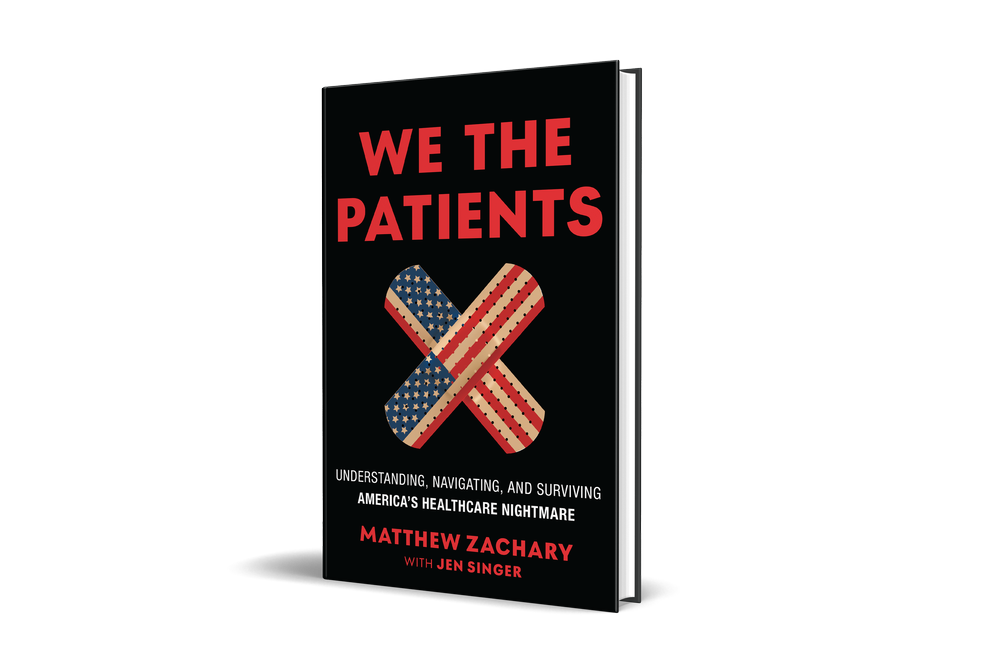
Matthew didn’t write a memoir. That surprised people.
“Most people that write books that have trauma write a memoir,” he explains. “And there’s nothing wrong with that. But I didn’t feel that that was what the readership of the country needed to hear or feel or see or think.”
Instead, he wrote a policy book. A call to action. A patient rights manifesto for a moment in American history when health insurance has become predatory.
The book reaches back to 1910, when Teddy Roosevelt proposed universal healthcare and J.P. Morgan essentially paid the American Medical Association to block it. It spans a century of American healthcare history. But it focuses on now, on a moment when the Affordable Care Act is under attack, when drug companies are exploiting loopholes, when insurance companies are denying life-saving treatments, when families are diluting baby food to afford chemotherapy.
“This book is written now and not earlier,” Matthew says, “because we’re at a critical point in American history.”
He’s experienced the full arc: global thermonuclear war threats of the Cold War, 9/11, recessions, pandemics. But today’s threat is different.
“The one missing thing now is the next great second generation of patients rights movements.”
The Single Issue: Health Insurance Can't Be the Gatekeeper to Life
What unites the cancer community? What single issue could mobilize millions of patients, caregivers, families, and doctors?
Matthew’s answer: No one should go broke or be denied care because of health insurance.
That’s it. That’s the issue.
It doesn’t matter if you’re conservative or liberal, Christian or Jewish, straight or gay, black or white. That single threat, the possibility that a corporate algorithm might determine whether you live or die, affects everyone.
“I don’t care who you voted for,” Matthew says. “But no one voted to have this happen to them and their families. No one wants their health insurance to bankrupt them. No one wants health insurance to get in the way of their care. No one wants their health insurance to play God and tell their doctor what to do.”
This is where advocacy becomes activism becomes organizing.
From Community Care to Civic Power
Matthew is careful to distinguish his original message from his new one.
“Cancer is not going away. There’s always going to be a need to be there for the next person. I’m not taking that away,” he says.
But there’s an “upstream strategy” now. A level above individual support.
The example he gives is Act Up during the AIDS crisis. They didn’t just support each other. They organized. They shamed. They made noise. They forced political response through the only thing that moves Congress: the threat of electoral consequences.
“What’s the one thing that every cancer patient, family caregiver would want beyond not dying?” Matthew asks. “That our doctors are our sacred bond. That we get access to the drugs we need. That health insurance isn’t our Lord and savior determining whether we live or die.”
Advocacy 2.0 is organizing around that single issue, dropping other agendas, recognizing that this threat is greater than any political difference.
“Organizing is really about dropping your ego, dropping your other political agendas,” he explains. “You organize under that specific issue. I don’t care if you’re gay, straight, black, brown, green, blue. No one that I’m aware of wants health insurance to bankrupt them.”
A Day in the Revolution
If barriers disappeared—no gatekeepers, no budget limits, no waiting for permission—what does one day of Matthew’s revolution actually look like?
It looks like millions of people unified around the principle that health insurance should never determine who lives and who dies. It looks like politicians understanding that opposing healthcare reform is electoral suicide. It looks like regulations, oversight, and transparency on insurance company denials.
It looks like doctors being trusted. It looks like treatments being available. It looks like families not being bankrupted by the cost of staying alive.
“The civil liberties of the cancer community are not infringed upon by the private sector’s profit motives,” he says simply.
A Piano, a Tumor, a Voice
Matthew Zachary didn’t set out to be a revolutionary.
He was a concert pianist. Then he was a survivor. Then he was a community builder. Then he was an entrepreneur running a nonprofit.
And now he’s an organizer.
The loss of his left hand meant he could never be a classical concert pianist again. But it freed him for something larger—speaking into a microphone, building community, organizing civic power.
“What do you do with the mad that you feel?” he quotes Mr. Rogers.
For Matthew, the answer is: organize. Build movements. Refuse to accept that health insurance companies should determine who lives and who dies. Write a book that explains why. Ask millions of Americans to understand that they have power when they organize.
The piano was one path. This is another.
And it might change healthcare in America.
Connect With Matthew and “We The Patients”
If you’re ready to organize:
Website: wethepatients.org — Take the national poll on healthcare and find the book
Book: “We the Patients” — Available everywhere books are sold
Personal Website: matthewzachary.com
Learn More: About organizing for healthcare reform and joining the patient rights movement
Stupid Cancer: The community he founded that continues to serve young adult cancer survivors
I have one specific request: please take their unprecedented, bipartisan national poll on consumer perspective of healthcare. This data matters. Your voice matters.
Final Thoughts
Matthew Zachary survived pediatric brain cancer in an era when most pediatric cancer patients didn’t survive. He built a community that changed what it meant to be young and sick in America. He mentored thousands of people.
But his greatest work might be what he’s doing now: organizing.
Because you can survive cancer and still lose everything to medical debt. You can beat your tumor and have your treatment denied by insurance. You can do everything right and still be destroyed by a system that prioritizes profit over people.
Matthew is asking us to organize. To drop our other agendas. To recognize that we have power when we unite around a single issue: the belief that health insurance should never determine whether we live or die.
That’s not politics. That’s not partisanship. That’s basic human dignity.
And it might just be the revolution we need.
Are you fighting health insurance denials? Watching insurance companies override your doctor’s recommendations? Consider organizing. Connect with We the Patients. Read the book. Take the poll. Because alone, we’re patients. Together, we’re a movement.


