


The news is not what I wanted. My Guardant Reveal test came back positive. There is cancer in my body again.
I sat with that for a while before I wrote a single word.
Then I felt something I did not expect. Gratitude.
Here is why.
What a positive result actually means
Guardant Reveal is a blood test. It looks for circulating tumor DNA. These are tiny fragments of cancer that shed into the bloodstream. The test can find them long before a tumor is large enough to appear on a scan.
That last part is the part I need you to understand.
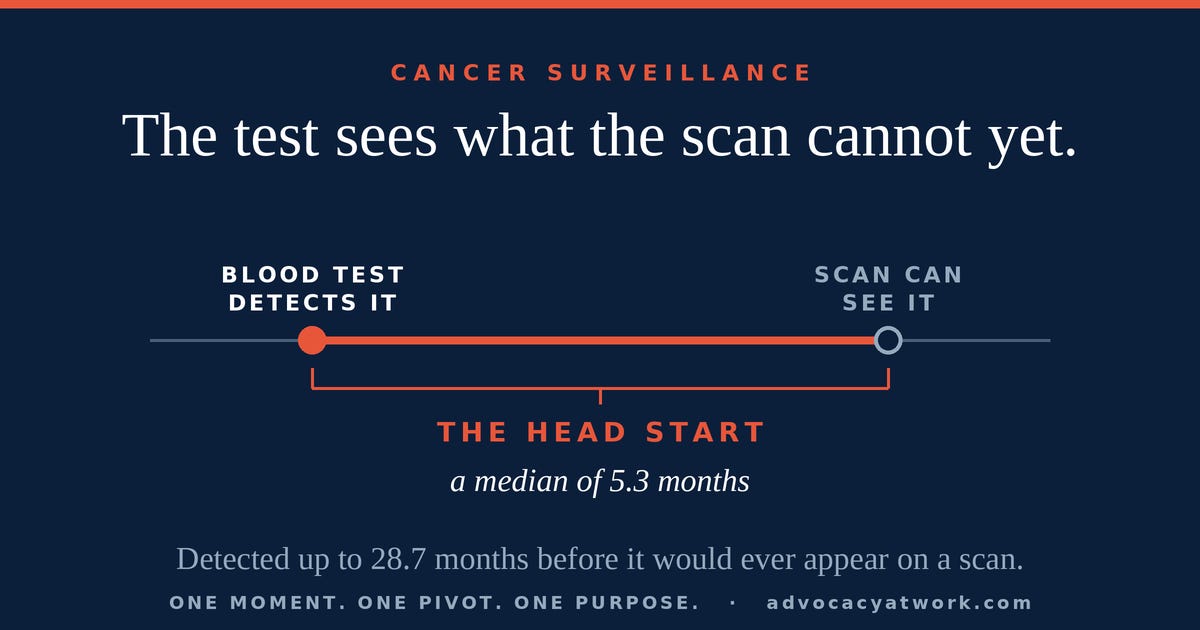
In the COSMOS study of Guardant Reveal, published in Clinical Cancer Research, a positive result showed up a median of 5.3 months before recurrence was visible on imaging. For some patients, the lead time stretched well past two years. The longest recorded was 28.7 months.
Across the broader research on ctDNA in colorectal cancer, that median lead time runs around 8.7 months. Some studies report up to 11 months.
Read that again. Months. Sometimes years.
The test can see what the scan cannot see yet.
My surveillance plan
Since my treatment, my oncologist has been running CT scans every six months. That is good care. It is the standard.
After three years of clear scans, we were feeling confident. The plan was to move to annual imaging. That is also standard. Also reasonable.
Now walk through what that plan means in a world without the blood test.
The scan-only timeline
Imagine my Reveal test does not exist. I am relying on imaging alone.
I get a clean scan. Everything looks clear. I exhale. I go live my life.
But the cancer is already there. Too small to see. Below the resolution of the machine.
It grows. Quietly. For months.
On a six-month schedule, my next scan is half a year away. On an annual schedule, it is a full year away.
The disease does not wait for my appointment. Research that tracked patients from their first positive blood result to the moment disease became visible found that tumor burden does not hold steady in that window. It climbs. One analysis measured roughly a fifty-fold increase in circulating tumor DNA while patients waited for the cancer to grow large enough to detect.
So the scan that finally catches it is not catching it early. It is catching it after months of unchecked growth.
That is the version of this story I did not have to live.
The gratitude
The Reveal test caught the signal now. Not in six months. Not next year. Now.
Whatever comes next, I am starting from a smaller, earlier, more treatable place than I would have been if I had waited for a scan to sound the alarm.
That is the head start I am grateful for.
What this means for you
If you are a survivor, or you love one, here is the advocacy inside the story.
Ask your oncology team about ctDNA testing and whether it belongs in your surveillance.
Know your scan schedule, and understand what imaging can and cannot catch.
Remember that a clear scan is not the same as no cancer. It is the absence of visible cancer.
You are the General Manager of your own healthcare. Draft the best team you can. Use every tool on the table.
The wound becomes the wisdom. The wisdom becomes the work.
More soon. I am not going anywhere.
Tim, I’m so sorry you have to endure more but am so thankful that you had the blood test available to you for early detection. Saying prayers for your journey ahead 💙
Thank you for sharing such a deeply personal experience. As a physician-scientist, I think cancer recurrence is one of the most difficult moments in medicine, not only because of the biology of the disease, but because it fundamentally changes how patients experience uncertainty.
One aspect that often goes unspoken is that recurrence is not a reflection of something a patient did or didn’t do. Cancer is an evolutionary process. Even after successful treatment, microscopic populations of cells can persist, adapt, and eventually re-emerge despite receiving the best available care. Understanding that biology doesn’t make recurrence easier, but it helps shift the narrative away from self-blame.
I also think stories like yours remind us that oncology is about far more than imaging studies, biomarkers, or treatment protocols. It is about helping people navigate fear, hope, resilience, and the uncertainty that accompanies every scan and every follow-up appointment. Those human dimensions are just as important as the scientific ones.
At the same time, there is genuine reason for optimism. Advances in molecular profiling, circulating tumor DNA, immunotherapy, and precision oncology are transforming how we detect and treat recurrent disease. While we still have much to learn, the therapeutic landscape today is vastly different from what it was even a decade ago.
Thank you for your honesty. Sharing experiences like this really helps bridge the gap between the science of cancer and the lived reality of those facing it, reminding all of us in medicine what our work is ultimately about.