


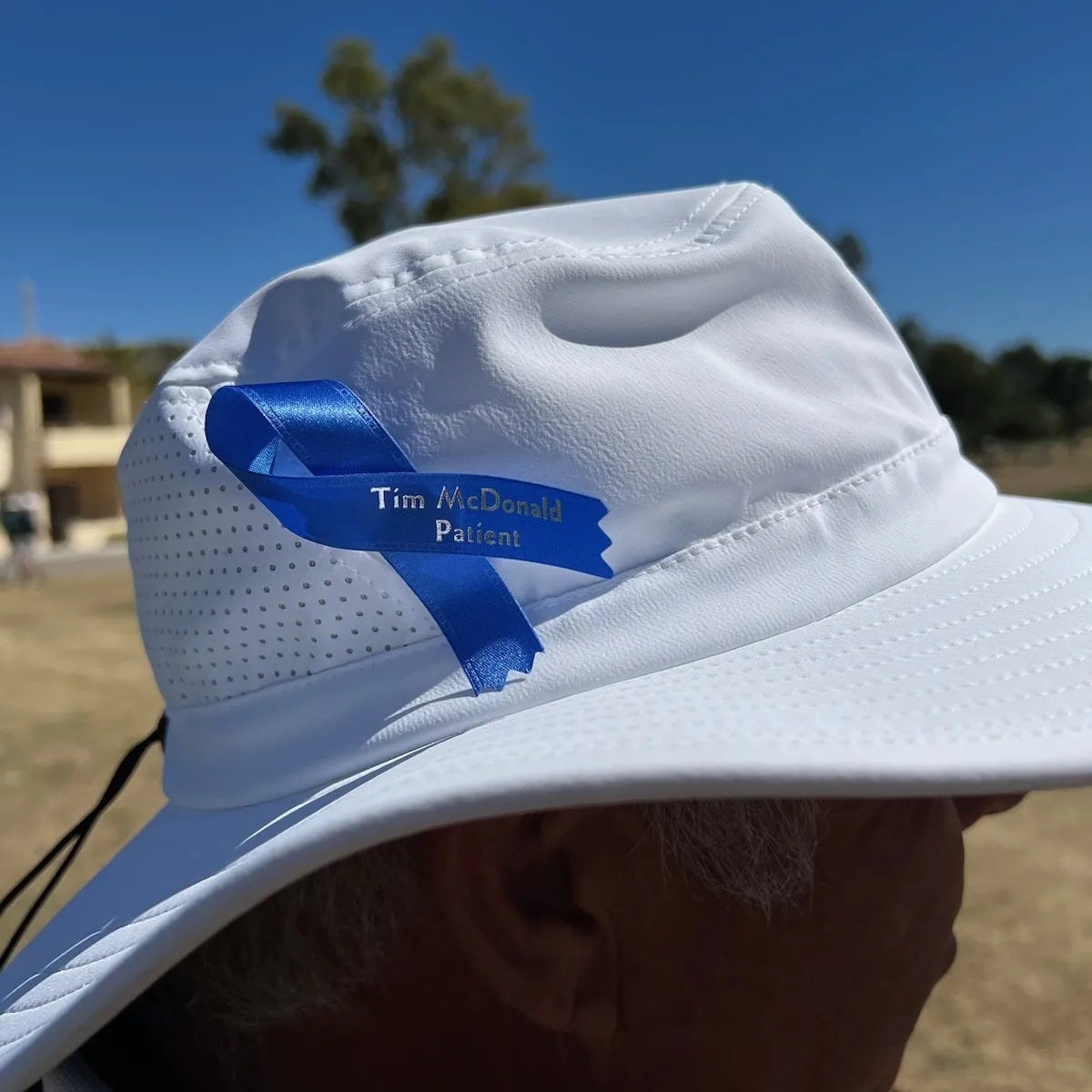
"Kirk Triplett wearing my name at the Cologuard Classic — a reminder that this work has never been mine alone."
I’m not publishing a new episode this week.
Not because there’s nothing to say. I have two conversations recorded and ready to go that I genuinely can’t wait to share with you. One is about Type 1 Diabetes. One is about traumatic brain injury. Both reminded me why I started this podcast in the first place.
But with Memorial Day weekend here, I’m giving us both a pause. A chance to breathe, to reflect, and if you’ve missed anything along the way, to catch up.
When I launched Advocacy at Work last fall, I had a single conviction: the real work of advocacy is happening everywhere — in hospital waiting rooms, at bathroom floors after chemo, at Pride festivals, in rural Appalachian communities, in Congressional hearing rooms, at 5K start lines — and my job was simply to find the people doing it and get out of the way.
Thirteen episodes later, I’m more convinced of that than ever.
Here’s what we’ve covered so far. Each one links directly to the episode. I hope you’ll share anything that resonates with someone who needs it.
Beyond Policy: How Corporate Advocacy Drives Real Change in Colorectal Cancer Screening Bryan Goettel, Director of Advocacy & Alliance Relations, Exact Sciences — November 2025
The episode that opened the season. Bryan helped me put words to something I’d long felt: a for-profit company can be a genuine partner in advocacy when the mission alignment is real. We talked about what the Cologuard Classic has built, how Exact Sciences approaches the advocacy community, and what it costs emotionally to build relationships in a space where people die. “The pain of losing somebody,” I told him, “is only eclipsed by the joy of knowing them.”
From Surviving to Serving Liz Healy (in Memory) — December 2025
Liz was hit by an out-of-control skier on a Vermont mountain in 2022. The imaging for a broken tailbone revealed kidney cancer, and a fourth surgeon at Memorial Sloan Kettering caught what three others had missed: stage four colorectal cancer already spread to her liver and lymph nodes. She was given a 7% chance of living five years. Three and a half years later, she’s run the New York City Marathon while on treatment, enrolled in a clinical trial at Mass General, and built a team of 20 runners whose lives have been touched by colorectal cancer. Her definition of advocacy: “Turning pain into purpose.” This one sets the tone for everything that follows.
The Long Game of Advocacy Anjee Davis, CEO, Fight Colorectal Cancer — January 8, 2026
Anjee has been leading Fight CRC long enough to watch the community go from support groups too embarrassed to fill a room to hundreds of advocates walking the halls of Congress. She helped pass the colonoscopy loophole bill — a ten-year effort. She built the Colorectal Cancer Care Report so that funders follow the mission, not the other way around. The line I keep coming back to: “If someone had said you shouldn’t do it in year one because you didn’t move it forward, we wouldn’t have had that passed.” The long game is the only game.
Finding Your Lane JJ Singleton — January 15, 2026
JJ was 27 when he was diagnosed with colorectal cancer, and he spent years on the bathroom floor after chemo watching athletes talk about overcoming adversity on TV. “Nobody ever shows this part,” he thought. A clinical trial saved his life. Then he discovered advocacy, almost by accident, saying yes to a 15-minute Zoom call that opened into an entirely different world. His focus is rural Appalachia: the communities that can’t reach a comprehensive cancer center, where nobody talks about the mental health spiral that nearly killed him faster than the cancer. He posts about the bad days, the suicidal thoughts, the ugly parts. He also breaks down something most advocates never discuss: how to make advocacy financially sustainable when you’re on Medicare and Medicaid.
Preventing Cancer Before It Happens Erin Peterson, Senior Director of Mission and Partnerships, Colon Cancer Coalition — January 22, 2026
Erin runs the mission side of the Colon Cancer Coalition, the organization behind Get Your Rear in Gear, now 40 events a year across North America and the Bahamas. What makes it work is how it grew: not through top-down corporate strategy, but by waiting for someone in a new city to raise their hand and say “I want to do this here.” Erin makes a point that stops you cold: colorectal cancer is one of the only cancers we can actually prevent — not just detect early, but prevent — by removing precancerous polyps. And the barriers to screening are rarely medical. They’re transportation, childcare, time off work, and the cost of bowel prep.
From Stage Four to a Movement Trevor Maxwell, Founder, Man Up to Cancer — January 29, 2026
Trevor was 41 when he was diagnosed with stage four colon cancer and began withdrawing from everyone he loved. He noticed that in every support space he entered, the ratio was the same: three women for every man. Men weren’t showing up to ask for help. They were isolating instead. So he built something specifically for them. Man Up to Cancer now has 40 chapters across North America, an annual Gathering of Wolves retreat, and a Chemo Care Backpack Program, all completely free to men in the cancer community. His definition of an advocate: “A role model.” I serve as Florida Chapter Leader for Man Up to Cancer, and this conversation meant a great deal to me personally.
Building Careers and Movements Michael Holtz — February 5, 2026
Michael has been doing cancer advocacy work for 23 years, longer than most people in the space realize. It started professionally at the American Cancer Society. It became personal when he was diagnosed with stage three rectal cancer in 2012, and he went fully public: diagnosis, treatment, life with an ostomy, all of it. Over two decades he’s run four forms of advocacy in parallel: media, legislative testimony, research peer review, and now as board chair of Man Up to Cancer. His north star after all of it: “That one day kids will ask, what the heck was cancer?” He also carries the names of those he’s lost on the back of his shirt, including his dear friend Ryan, who died pursuing a clinical trial. He doesn’t look away from that part of the work.
From Isolation to Impact Allison Rosen — February 19, 2026
Allison was 32 and in the best shape of her life when she was diagnosed with early-onset colorectal cancer. She went looking for a young adult support group at MD Anderson, one of the nation’s premier cancer centers, and found that one didn’t exist. So she helped create it. Thirteen years later she’s one of the most thoughtful voices in research advocacy, and she’s given us a frame I’ve been thinking about ever since: “Lived Experience Expert.” After the names on our charts, she says, it should read LEE. We didn’t get a PhD, but we are experts in our experience, and that expertise belongs at the research table from the very beginning, not as a checkbox at the end.
The Power of Showing Up Casie Shimanski, Founder, Team Live Out Loud — February 26, 2026
Casie has raised nearly $200,000 for children’s cancer research through St. Baldrick’s Foundation — one year, one ask, one shaved head at a time. She’s been a top fundraiser for eight consecutive years. When people ask how she does it, they want an easy answer. Casie’s answer is harder: consistency. “Most people don’t want to hear that,” she says. “They want the easy answer and there’s not one.” She first raised $600. She didn’t even shave that year. She just showed up. That’s still the whole strategy.
Speaking About the Unspeakable Marielle Santos McLeod, Director of Strategic Programs, Cancer Hope Network — March 19, 2026
Marielle is nine years out from her colorectal cancer diagnosis and has made it her life’s work to break the cultural silence that costs Latino lives. We talked about what it takes to make colonoscopy prep a normal topic in communities where talking about it — let alone cancer — is simply not done. “We don’t talk about things like these,” she says. “Oftentimes as Latino patients we’re diagnosed automatically at later stages.” She’s also one of the sharpest minds in clinical trial advocacy I’ve encountered, and she carries with her a message for every patient: know your biomarkers from day one. Don’t wait to be told.
Beyond “Just a Rash” Nora Eigenbrodt, Associate Director for Grassroots Advocacy, National Eczema Association — April 2, 2026
Thirty-one million Americans have eczema. Most of the world thinks it’s a minor inconvenience. Nora is working to change that, through a three-track ambassador program spanning legislative work, community engagement, and research literacy. She also told me something I didn’t know: through sustained advocacy, the National Eczema Association got eczema added to the Department of Defense’s Peer Reviewed Medical Research Program for FY25 and FY26. That’s not a small thing. That’s the long game paying off. Her reminder: Congress is a marathon, not a sprint.
From Butt Pics to Public Health David Russo, Founder, Cheeky Charity — April 16, 2026
David built a movement out of a converted Sprinter van, a cross-country road trip through national parks, and a willingness to post cheeky photos of himself on Instagram paired with public health messages. What started as a quirky personal project is now a 501(c)(3) nonprofit with a Butts and Badges program that has put 15,000 pins on healthcare providers across the country, a growing Pride Festival presence, and a new education platform at ScreenYourButt.org. He is also, by his own admission, a very large introvert. Which honestly makes the whole thing even better.
When Your Child’s Diagnosis Becomes Your Calling Jessica Cella — April 30, 2026
Jessica’s son was diagnosed with primary adrenal insufficiency at Rady Children’s Hospital in San Diego in January 2019. She was told that if he ever went into an adrenal crisis, the paramedics who responded couldn’t give him the medication he needed — they couldn’t administer it. So she trained 1,100 paramedics. Then she worked with San Diego to develop a brand-new protocol that takes effect July 1st of this year. She was named 2026 California Senate District 40 Woman of the Year. She told me something I’ve been sitting with since: “I don’t actually advocate for my son. I advocate for children and families who don’t have the luxury my family has.” She didn’t need Capitol Hill to save lives. She needed her neighborhood.
What’s Coming Next
We’re back next week with two conversations I’ve been looking forward to sharing, one focused on Type 1 Diabetes advocacy and one on traumatic brain injury. Both reminded me that the wound really does become the wisdom, and the wisdom really does become the work.
If you’ve been here since the beginning, thank you. If you’re finding this for the first time, start anywhere, every episode stands on its own. And if you know someone who needs to hear any of these stories, please share.
Enjoy the long weekend. I’ll see you on the other side.
— Tim